
Orchestrating Multi-Agent Workflows with MCP & A2A
Alexandra Quinn | August 11, 2025
Multi-agent workflows are the latest technological gen AI advancements. In this blog, we explore how to develop such systems, overcome operational challenges, improve system observability, and enable seamless collaboration between agents in complex AI pipelines. We’ll cover architecture, A2A and MCP protocols and introduce Google Cloud’s agentic marketplace.
This blog is based on a webinar with Yaron Haviv, co-founder and CTO of Iguazio (acquired by McKinsey) and Moe Abdula, VP Customer Engineering, Google Cloud APAC, which you can watch here.
3 Generations of Gen AI Innovation
In just a few years, the accelerated development of generative AI has already brought three generations of innovation.
- 2023 - LLMs that were accessible through chatbots, like ChatGPT and Claude.
- 2024 - RAG that drove co-pilots, like Microsoft co-pilots or Google’s Vertex AI Search.
- 2025 - Agents and reasoning models that enable complex workflow re-engineering, like OpenAI Operator and Amazon Alexa.
In this blog, we’ll explore the third generation of gen AI: AI agents.
What is Agentic AI?
AI agents are autonomous, decision-making AI systems that are capable of reasoning, tool usage and self-improvements. Agentic AI automates complex workflows, enhances productivity and operational efficiency and enables decision-making by acting as a thought partner.
However, agentic AI also comes with challenges. These include the need for the workforce to adapt to the new tech and capabilities; errors, hallucinations and biases; high costs and latency due to LLM and API calls; risks like privacy, data security, ethical concerns, and trust in models; and the need for governance through HITL systems, monitoring, guardrails and more.
Manual Processes vs. Agentic Workforce: Benefits and Risks
| Manual Processes | Agentic AI Systems | |
| Decision-Making | Rigid and error prone | Dynamic and fast, requires oversight |
| Scalability & Efficiency | Limited, repetitive and slow | Seamless, can handle complexity but operational complexity increases |
| Security & Compliance | Lower attack surface, compliance managed by humans | Expanded attack surface; vulnerable to prompt injection & identity compromise; requires robust governance |
| Human Impact & Governance | Clear accountability | Risks job displacement and ethical challenges; needs transparent oversight |
How Agentic AI Works
Agentic AI systems have the following core capabilities:
- Creating and implementing action plans based on human input, based on breaking plans into smaller tasks until each is executed reliably
- Autonomously using tools (e.g., RAG, APIs, web browsing, ML models, code execution) to process data and integrate with existing systems
- Gathering information through text, image, video, and audio, and also input from upstream/downstream systems
- Creating feedback loop to iterate outputs then codify recipes
To achieve this, these systems require:
- Explicit goal management and dynamic planning
- Real-time perception and contextual awareness
- Integrated memory for learning from experience
- Multi-agent orchestration for complex, distributed tasks
- Specialized frameworks that support chaining, modularity, and transparent decision flows
- Tighter monitoring, control, and governance
The Agentic AI Architecture
Here’s what a typical architecture of an agentic AI system looks like:
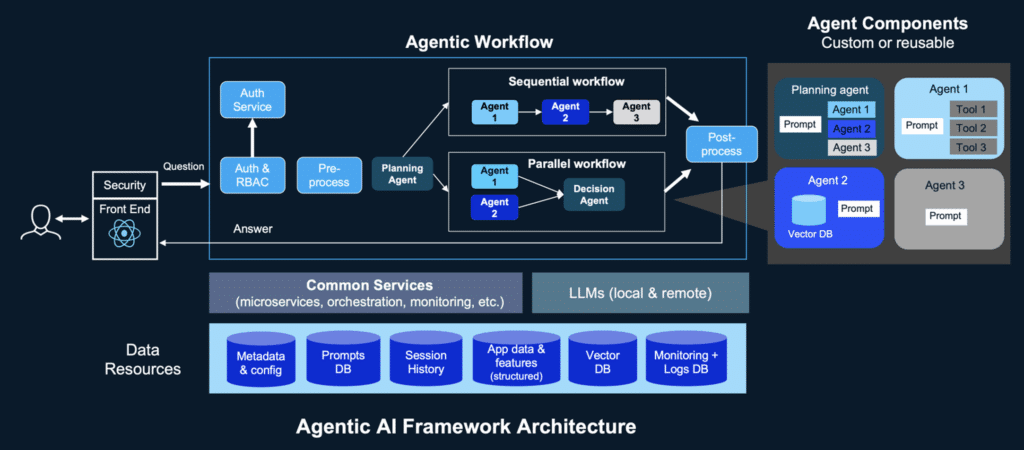
- It includes a data layer with operational data (logs, monitoring, configuration), application data (vector databases, key-value stores, graph databases), and contextual data (session history, Q&A records, managed prompts).
- Above this is a service layer using orchestration and infrastructure tools like Kubernetes, monitoring and observability, and an LLM layer where models run locally or via external providers.
- On top sits the workflow layer, which combines general steps (authentication, preprocessing, postprocessing, guardrails) with agentic AI workflows.
- In these workflows, tools carry out specific tasks or connect to external systems, while agents coordinate and operate those tools.
How Do We Support the Evolution to Multi-Vendor and Multi-Agent?
Operationalizing agentic AI requires the ability for agents to communicate with each other and to be able to guide each other. They are no longer “simple” API, but rather advanced systems that understand context and interact with various systems.
This requires:
- Capability Discovery - Agents must advertise their capabilities so clients know when and how to utilize them for specific tasks.
- User Experience Negotiation - Clients and agents need to agree on communication methods like text, forms, iframe, or audio/video to ensure proper user interaction.
- Task and State Management - Clients and agents need mechanisms to communicate task status, changes and dependencies throughout task execution.
- Collaboration - Clients and agents must support dynamic interaction, enabling agents to request clarifications, information, or sub-actions from clients, other agents, or users. Collaboration means being able to invoke and execute on behalf of another agent, retrieve certain data, etc.
Introducing the A2A Protocol
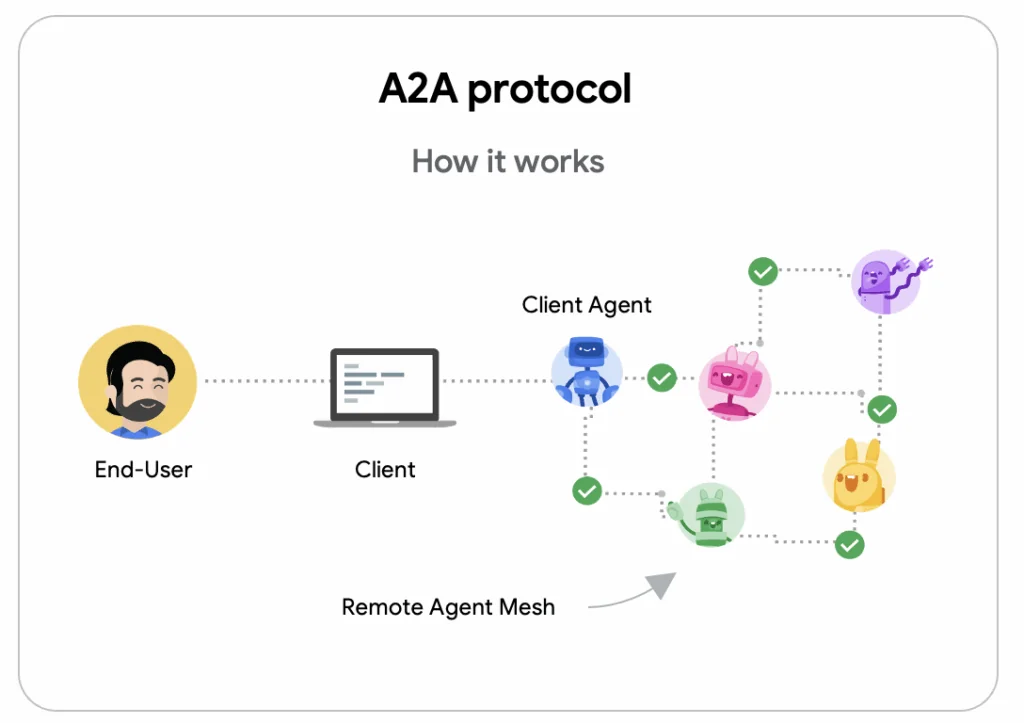
A2A (Agent2Agent) is a standard for agent-to-agent collaboration. Developed as an open standard by Google, Atlassian, Box, Cohere, Intuit, Langchain, MongoDB, PayPal, Salesforce, SAP, ServiceNow, UKG, Workday, and many others, A2A is designed to handle the dynamic and multi-modal nature of agent collaboration.
A2A is built on top of existing popular standards, including HTTP, SSE and JSON-RPC and is designed for a secure and governed experience.
With A2A, organizations can plug in the A2A framework and leverage existing agents without building everything from scratch.
Connecting Agents to Tools and Other Agents Using MCP and A2A
MCP (Model Context Protocol) is a protocol that enables agents to reliably connect to and retrieve information from diverse tools and data sources. These include APIs, databases, cloud storage, and enterprise systems.
A2A and MCP complement each other. While A2A focuses on enabling discovery, capability-sharing, and collaboration between agents, MCP focuses on giving agents consistent, governed access to the data and tools they need. Together, they form the foundation for multi-agent systems, with A2A handling inter-agent coordination and MCP handling the data access layer.
Building a Coordinated Agentic AI System
Composition is an architectural design that combines multiple agents, tools, or resources into a coordinated system. It allows workflows to access LLMs, agents, tools, and data resources without needing them all in the same cluster. The components can be developed and managed by third parties, cloud providers, or delivered as source code, ready-made containers, or hosted services.
Standards like MCP and A2A enable this, improving scalability, observability, and version control.
Organizations can consume these components in three ways:
- Building and serving your own container (often serverless)
- Deploying a pre-built, protocol-compliant container
- Accessing fully hosted external services
For example, Google Cloud is developing an agent ecosystem, called Agentspace, which provides access to building and deploying agents for both technical and non-technical users. It also includes an agent marketplace, where creators publish agents for others to use.
Learn More
To learn more about Google’s AgentSpace, the A2A protocol and what it takes to build and deploy agentic AI, watch the full webinar here.
The recording also includes a live demo of a multi-agent AI workflow in the Agentspace, simulating a small software engineering team that speeds up prototyping. The workflow included agents that:
- Orchestrated the process, analyzed a product requirements document, and created an implementation plan.
- Interpreted requirements and structured outputs.
- Generated the code.
- Handled deployments.
- Detected and fixed bugs and failed test cases.

